Trixie’s entrepreneurial start-up phase
It Must Be Love: A Mustang Prairie RomanceTrixie’s entrepreneurial start-up phase traces the transformation of an intimate fantasy into a functioning lingerie business. What begins as a quiet vision for shelves filled with her own designs becomes a sequence of concrete decisions involving branding, municipal approval, web commerce, production, staffing, promotion, and public presentation. The business is not merely a subplot or source of income: it is the material structure through which Trixie Beaumont reclaims authorship of her life after divorce and turns creative confidence into a form of independence.
Dream, Independence, and Opportunity
Trixie’s first commitment to the venture is emotional before it is commercial. During the quietest part of the day at her shop, she imagines lingerie for women of every kind, made in sexy cuts and vibrant colors. The empty store gives her a private rehearsal space for the future: the existing shelves represent the retail business she already operates, while the designs she imagines occupying them represent a more ambitious identity as a creator. Mustang Prairie becomes important because she sees the town as a source of creative inspiration and as a setting where designing, making, and selling might be possible together.
That dream is explicitly connected to freedom from her former husband and his family. Trixie understands the new venture as something she can pursue because she is no longer living under oppressive discouragement or organizing her life around a husband’s expectations. Her parents offer a contrasting kind of instability. They are generous, capable, adventurous hippies, but emotionally distant and perpetually moving toward another hobby, belief, or destination; while traveling through South America in a new RV, they may be absent for months or years. Trixie therefore begins without dependable emotional reinforcement. Her confidence sometimes wavers, but the absence of family support also sharpens the necessity of building a life that does not wait for anyone else’s permission.
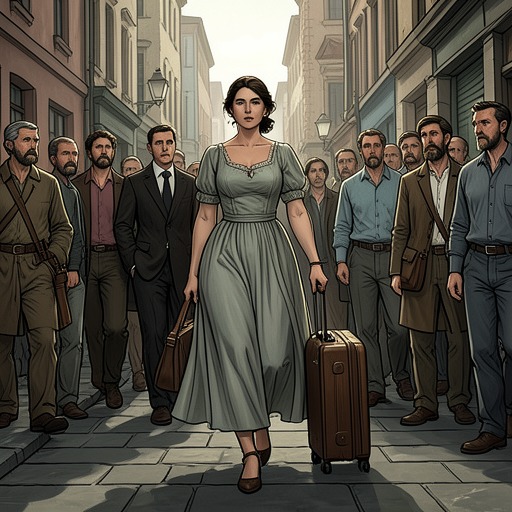
The start-up remains uncertain for months. Trixie experiments with possible names, sketches logo concepts, and even contacts a graphic designer to develop them. Once the logos exist, however, they become reminders of her inaction rather than evidence of progress. The decisive change comes when she dresses deliberately for a visit to City Hall and walks from the apartment above her shop to seek approval for a sewing or knitting class. Her clothing signals confidence even as she feels nervous: a red polka-dot dress, red heels, a sweater, and a black beaded handbag accompany the first formal step toward creating the resources her business will need.
Building the Brand and Its Market
At City Hall, Trixie explains to Eric that she wants to establish a class but does not yet trust her technical skills enough to design the line alone. She describes the ambition in local terms, imagining a label that would read “Made in Mustang Prairie.” Eric explains the registration process, including the small room-rental fee, the requirement to leave the space as she found it, and the arrangement for advertising the class on the town website. His assistance turns a vague aspiration into an approved, actionable program. Trixie leaves with the unsettled realization that she is no longer merely considering the venture; she is doing it.
Her brand identity develops through sustained design work rather than a single flash of inspiration. She eventually names the first line Slinky Things, then refines its commercial concept as Sexy Separates by Trixie. The collection is built around choice: six to ten styles of panties, from g-strings and bikinis to French cuts and possibly a boy cut, in silk, lace, and cotton; four bra styles, including a convertible option; and a rainbow palette designed to encourage women to mix and match. Trixie’s own pleasure in coordinated lingerie does not become a universal rule. Sadie’s habit of combining different colors in her drawer helps Trixie recognize that customers may want the freedom to assemble their own combinations.
The line’s mix-and-match principle therefore carries both a market strategy and a view of women’s self-presentation. Trixie is not selling a single prescribed version of attractiveness. She is designing alternatives that accommodate different tastes, colors, fabrics, and degrees of coordination. Her business joins sensuality to agency: the garments are explicitly sexy, but the customer’s ability to choose and recombine them is part of the product’s meaning.
By this stage, Under the Skirt Online is officially open and has produced several consecutive months of profit. Trixie imagines renting the neighboring space as a warehouse that could also become her work area, and she begins considering the possibility of hiring a part-time worker earlier than her business plan predicted. Yet she refuses to treat growth as proof that every risk is justified. She knows that the store is her livelihood, career, and stability, and she is determined to protect it rather than gamble it away.
Labor, Control, and Expansion
The physical work of the start-up repeatedly tests the difference between entrepreneurial vision and daily labor. After injuring her foot and spending a nearly sleepless night on Jack Thorpe’s couch, Trixie arrives at the shop exhausted and in pain. She cannot refold or steam the merchandise, so she limits herself to shouting instructions and operating the digital register, whose battery backup suits someone who does not trust her mathematical abilities. Even while injured, she uses the quiet first half of the day to work over a sketchpad, turning lost physical capacity into design time. The business survives because she continually shifts between sales, inventory, maintenance, and creative planning.
The venture also develops through improvised spatial expansion. Trixie takes Jack through the shop, the break room, and into the space next door, where a newly opened hole is hidden behind a curtain. The contractor, Derek Hayes, cannot begin until Black Friday, so the future work area exists first as an unfinished, slightly embarrassing construction project. The scene makes expansion concrete: the business is not an abstract brand but a set of rooms, shelves, orders, tools, and building decisions that must be coordinated before the line can scale.
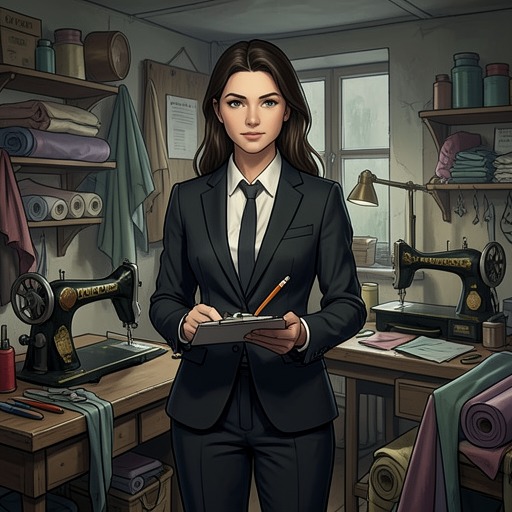
Trixie’s relationship to production becomes clearer when Jonquil Spring helps rank seamstresses in the workshop. Jonquil suggests reconsidering the process and using a manufacturer, but Trixie resists outsourcing at this early stage because she wants total control over quality. Her decision is cautious rather than romantic. The brand is new, and she believes that direct oversight is necessary until its standards are secure. She is willing to consider a manufacturer after the line becomes solid, but not before she has established what the line should be.
This insistence on control reveals the discipline beneath the fantasy. Trixie does not simply want her name attached to lingerie; she wants responsibility for the workmanship that name promises. At the same time, the business is beginning to move beyond solitary labor. She interviews seamstresses, organizes their work, and imagines a future in which production and retail can be divided among employees. The start-up thus passes through a transition from one woman’s hands to an organized labor process without surrendering the quality authority she considers essential.
Promotion, Performance, and Public Launch
Trixie understands that a product line requires an audience as much as it requires designs. She creates a basic website and plans to have someone refine it and add online ordering features. She also imagines a special area called Trixie’s Corner, a branded space that would give the online business a recognizable personal center. The plan joins digital expansion to the intimate, handmade feeling of the physical shop: customers are meant to encounter both a purchasable product and the designer’s presence behind it.
Promotion also depends on the bodies and visibility of people close to her. Trixie plans to photograph Sadie in the collection and use those images to promote the line. Orders have begun to arrive at a rate higher than expected, but they are still too few to celebrate without reservation, so she treats the photographs as a way to make the brand legible and desirable. The strategy is practical, yet it also reflects the social world of Mustang Prairie, where friends provide music, modeling, photography, encouragement, and access to local venues.
The launch takes place in Dylan’s bar, transformed into a makeshift runway. The room is split by a catwalk, gauzy fabric hangs from the ceiling, and songs by Sadie and Kiki Ramirez provide the soundtrack. The setting turns an ordinary community business into an improvised fashion space, giving the collection a public life without separating it from the town that helped sustain it. Sadie opens the show in teal lace boy shorts and a matching Basque; later, white cheeky underwear, a matching bra, a silky duster with silver buttons, and cherry-red stilettos create the image Trixie believes could launch the line.
The runway changes the status of the garments. Before the show, they are sketches, samples, orders, and pieces of work distributed across a shop and workshop. Under the lights, they become a coherent brand with a tagline, “Sexy and fun.” Trixie watches the models move through the crowd and recognizes that the line has acquired a visual language of its own. When the models congratulate her backstage and she walks up the runway amid flashing lights, applause, and wolf whistles, the private enterprise becomes public fact: Sexy Separates by Trixie has officially launched, and the show is judged a success.
Stability, Community, and Personal Consequences
The success does not erase the loneliness attached to it. At the end of the launch, Trixie feels satisfied because she has accomplished what she set out to do, but she also recognizes that she has no one to share the achievement with in the fullest sense. The business grants her independence without automatically solving her emotional life. Its triumph therefore contains a precise contradiction: she has built something that belongs entirely to her, yet the freedom of ownership exposes the absence of the intimacy she once expected to find through marriage.
That contradiction does not send her back into passivity. After Christmas, a burst of creativity leads her to design new pieces for Valentine’s Day, including a black-and-pink bustier intended to be sexy and fun for women of different ages. The continuing work gives her energy and makes the mundane tasks of owning a shop more bearable. Orders are now hanging on the rack through the following week, and three seamstresses can leave for the weekend after completing the scheduled production. The image marks a clear operational change from the injured shopkeeper who could only ring up customers and give instructions: the venture now includes a small staff, an order calendar, and enough activity to structure other people’s labor.
The enterprise also becomes part of Trixie’s expanding household and community life. She works alongside Jonquil, whose presence brings brightness and responsibility into her days, while clothing becomes one of the ways Trixie helps Jonquil grow more comfortable in a semi-normal life. When Jonquil shows a chosen outfit—grey skinny jeans, an Einstein shirt, a red leather jacket, and black motorcycle boots—Trixie responds with immediate approval. The moment is not a business transaction, but it belongs to the same larger pattern: Trixie uses style, design, and practical care to help create identities that feel chosen rather than imposed.
Trixie’s venture also intersects with her complicated relationship with Jack Thorpe. He sees her work through its shop, its unfinished expansion, its provocative products, and the attention it attracts from men around her. His jealousy and attraction repeatedly accompany encounters connected to the business, but Trixie’s project is not presented as an extension of his desire. She continues designing, organizing, and making decisions whether or not Jack understands what she is building. His family’s recognition of her and his own emotional uncertainty may intensify the personal stakes, yet the line’s ownership and direction remain hers.
Narrative Significance
Trixie’s entrepreneurial start-up phase is the book’s clearest account of independence as a process rather than a declaration. She does not become self-sufficient by simply leaving a marriage. She learns to identify an opportunity, seek permission where permission is required, obtain help without surrendering control, test demand, coordinate labor, protect quality, and accept the emotional costs of success. Each stage replaces a former dependence with a concrete capability.
The venture also makes creativity economically consequential. Trixie’s sketches, color choices, logo, website, sewing class, photographs, and runway presentation are not decorative accessories to her personal growth; they are the means through which growth becomes visible and durable. Her lingerie line turns the language of sexual appearance into a field of creative authority. In doing so, it resists the discouragement that once made her doubt her technical competence and the marital pattern in which another person’s life could become more important than her own.
Most importantly, the start-up connects individual recovery to Mustang Prairie’s social fabric. City Hall supplies institutional access, local friends supply performance and promotion, Dylan’s bar supplies the launch venue, Jonquil becomes part of the household, and seamstresses make expansion possible. Trixie’s independence is not isolation. It is a form of self-directed belonging, built through work that she controls and a community that increasingly recognizes her as a designer, employer, and creator. The business’s decisive achievement is therefore larger than the successful launch of a lingerie collection: it gives Trixie a home in her own ambitions.